


For decades the recycling story was simple: collect, shred, melt, remold. That script is being rewritten. As the plastics industry prepares for PolyNext Awards & Conference 2026 in Dubai, a new narrative is emerging—plastic waste is shifting from nuisance to high-potential feedstock for advanced materials and circular supply chains.
Policy made this pivot inevitable. The UAE’s national ban on single-use plastic bags and its expanded restrictions on disposable items have accelerated attention to reuse and recovery. Layered atop that, expanding Extended Producer Responsibility (EPR) frameworks and global recycled-content mandates are pushing brands and recyclers toward higher-purity outputs and predictable material streams. What used to be optional innovation is now essential investment.
Technologies once confined to labs are approaching commercial reality. Chemical recycling methods—breaking polymers back into monomers or oil fractions—promise virgin-like quality where mechanical recycling stalls.
Supercritical water depolymerization and solvent‑based dissolution can reclaim high yields and ultra-pure resins from contaminated and multi-layer feeds. Enzymatic and catalytic depolymerization technologies for PET and other polyesters are advancing from proof-of-concept toward pilots that deliver food-grade monomers under mild conditions.
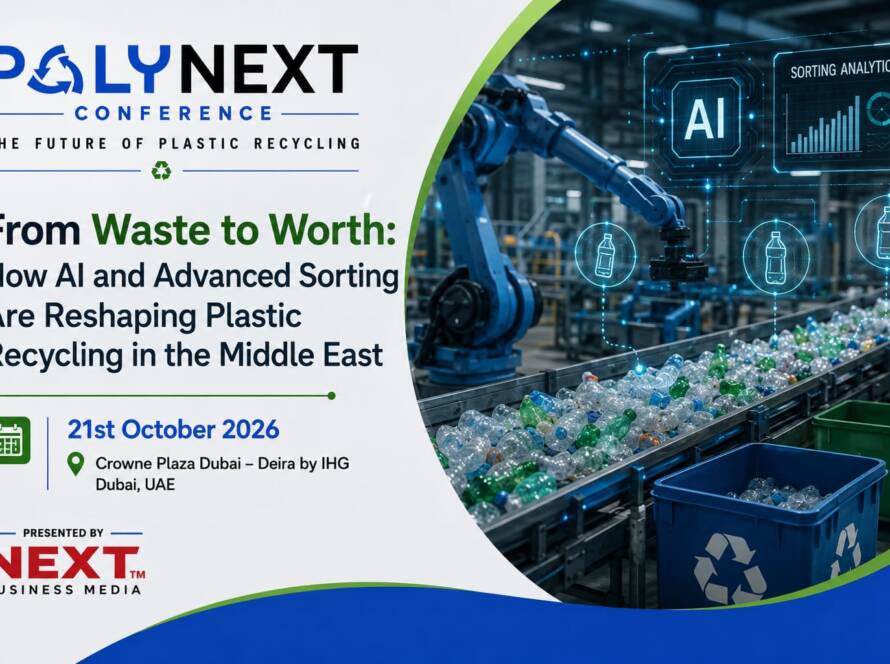
Flexible and small-format plastics, long the bane of sorting lines, are finding new routes back into the circular economy. Targeted collection trials, paired with vision-AI and robotics, are overcoming the limitations of traditional NIR sorters. Hyperspectral imaging, RGB, and 3D detection now identify crumpled, soiled, or multilayer films reliably, converting previously rejected material into valuable feedstock for both mechanical and chemical recovery.
Two complementary fronts aim to reduce cost and chemical intensity. Air-assisted oxidative degradation uses reactive oxygen species along with catalysts to cleave polymer chains at lower emissions and capital intensity; recent research shows high-yield recovery of terephthalic acid (TPA) from colored PET without heavy solvents. Radiation-based methods—electron-beam processing and controlled irradiation—offer routes to break down hard-to-handle fluoropolymers and to precondition plastics for easier recycling and sorting.
Other approaches—plasma-assisted processing, catalytic hydrothermal upcycling, and low-energy oxidation—remain at the demonstration stage but expand the range of recoverable polymers.
The practical takeaway is that no single technology will solve plastics. Instead, a systems approach—policy alignment, design-for-recyclability, advanced sorting, and a portfolio of chemical and mechanical recovery pathways matched to local streams—is required.
PolyNext 2026 (October 21, Crowne Plaza Dubai – Deira) aims to convene the stakeholders needed to build that circular system, including regulators, brand owners, materials scientists, and technology providers. Expect discussions that move beyond incremental improvements to explore how policy, innovation, and scale-up pathways can turn plastic waste into a reliable feedstock for next-generation materials—redefining what plastic waste can become.
 Reach us on WhatsApp