


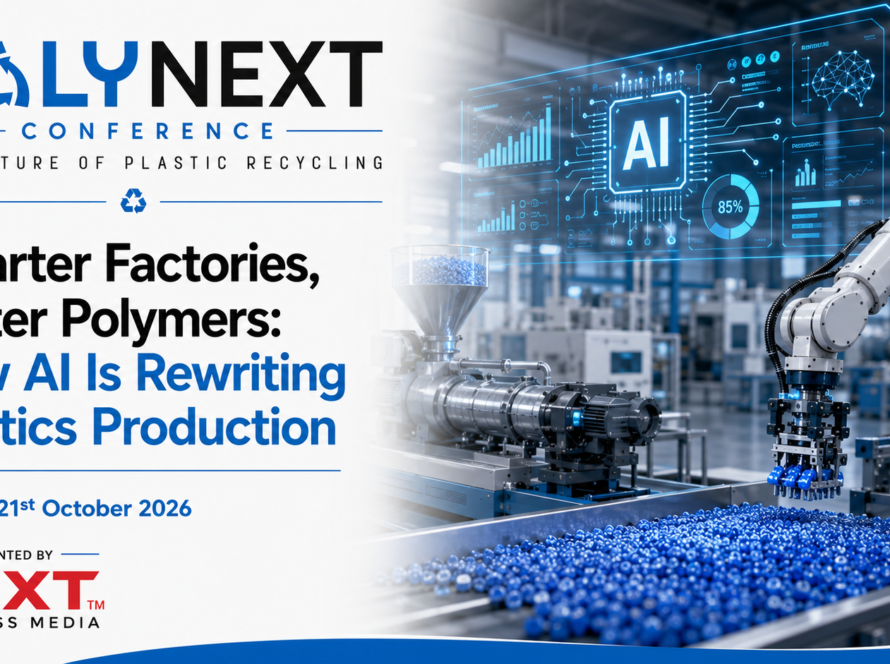
Plastics factories are getting smarter. By integrating artificial intelligence (AI) into production lines, manufacturers can reduce downtime, improve energy efficiency, and produce more consistent, higher-quality polymers. The shift is not simply about automation. It is about using production data in real time to identify patterns, optimize processes, and address problems before they become costly disruptions.
How AI Is Changing Plastics Production
AI is increasingly being applied across three important areas of plastics manufacturing.
Predictive maintenance: Sensors installed on motors, pumps, screws, heaters, and other equipment continuously collect operational data. AI models can analyze vibration, temperature, electrical current, and other signals to identify early signs of equipment degradation. Instead of waiting for a breakdown, maintenance teams can plan interventions during controlled production windows.
Process control and optimization: Machine-learning systems can analyze production conditions and help optimize temperatures, pressures, speeds, and other process parameters. This can help maintain stable output even when raw-material characteristics vary. In recycling, AI can also support process optimization by analyzing feedstock characteristics and helping operators adjust conditions in processes such as pyrolysis and solvolysis.
Quality control and sorting: AI-powered vision systems and spectroscopy can identify polymer types, contaminants, defects, and material variations. Automated inspection can provide faster and more consistent quality checks than manual inspection alone. In recycling facilities, AI-supported sorting can improve the identification and separation of difficult materials, helping increase the quality and purity of recovered polymers.
What This Means on the Factory Floor
For plastics manufacturers, AI can deliver three practical benefits:
Less downtime: Predictive models identify early signs of equipment problems, allowing planned maintenance.
More consistent output: Real-time monitoring helps keep critical process parameters within specification.
Lower waste and energy use: Better process control can reduce material losses, rework, and inefficient production.
From Pilot Projects to Scale
AI in plastics manufacturing is moving beyond experimentation. The Fraunhofer CCPE position paper highlights the potential of artificial intelligence to improve efficiency, quality, and circularity across the plastics value chain. It also points to the importance of data standards, interoperable systems, and viable business models for scaling AI applications.
In practice, scaling AI across plastics operations requires:
•Connecting machines, production systems, laboratories, and quality-control platforms through compatible data infrastructures.
•Developing explainable AI models that operators can understand and trust.
•Establishing clear data-governance frameworks for sharing information among producers, recyclers, suppliers, and brands.
•Ensuring that AI systems integrate with existing manufacturing execution, quality, and maintenance systems rather than operating as isolated tools.
AI in action
Injection Molding: Using AI to Optimize Production
Injection molding provides a clear example of how AI can support process optimization. AI-driven systems can analyze production parameters, identify relationships between process conditions and product quality, and help manufacturers optimize cycle times while maintaining specifications.
Recycling: AI Sorting for Difficult Materials
AI is also becoming increasingly important in plastics recycling, particularly where conventional sorting technologies struggle with difficult-to-identify materials.
Steinbeis Polyvert in Austria partnered with Sesotec on AI-supported sorting technology designed to identify challenging materials, including dark objects on dark conveyor belts. The system combines sensor technology with AI-based classification to improve the separation of materials and support the production of higher-quality recyclates.
Such applications demonstrate an important advantage of AI in recycling: the ability to extract useful information from complex material streams and turn it into faster, more precise sorting decisions.
From Smart Equipment to Smart Factories
The next phase is connecting machines, production data, quality systems, and maintenance into one intelligent manufacturing environment. AI can help plants detect problems, optimize processes, and support faster decisions across the production line.
PolyNext Awards & Conference Dubai
At PolyNext Dubai, the focus is shifting from whether AI can help to how it can be scaled. Smart factories, predictive maintenance, AI-driven quality control, and intelligent recycling are reshaping polymer manufacturing. Smarter manufacturing can help improve polymer quality, operational efficiency, and circularity. For producers, recyclers, and technology providers, the opportunity is to turn factory data into better decisions—and better decisions into better polymers.
 Reach us on WhatsApp