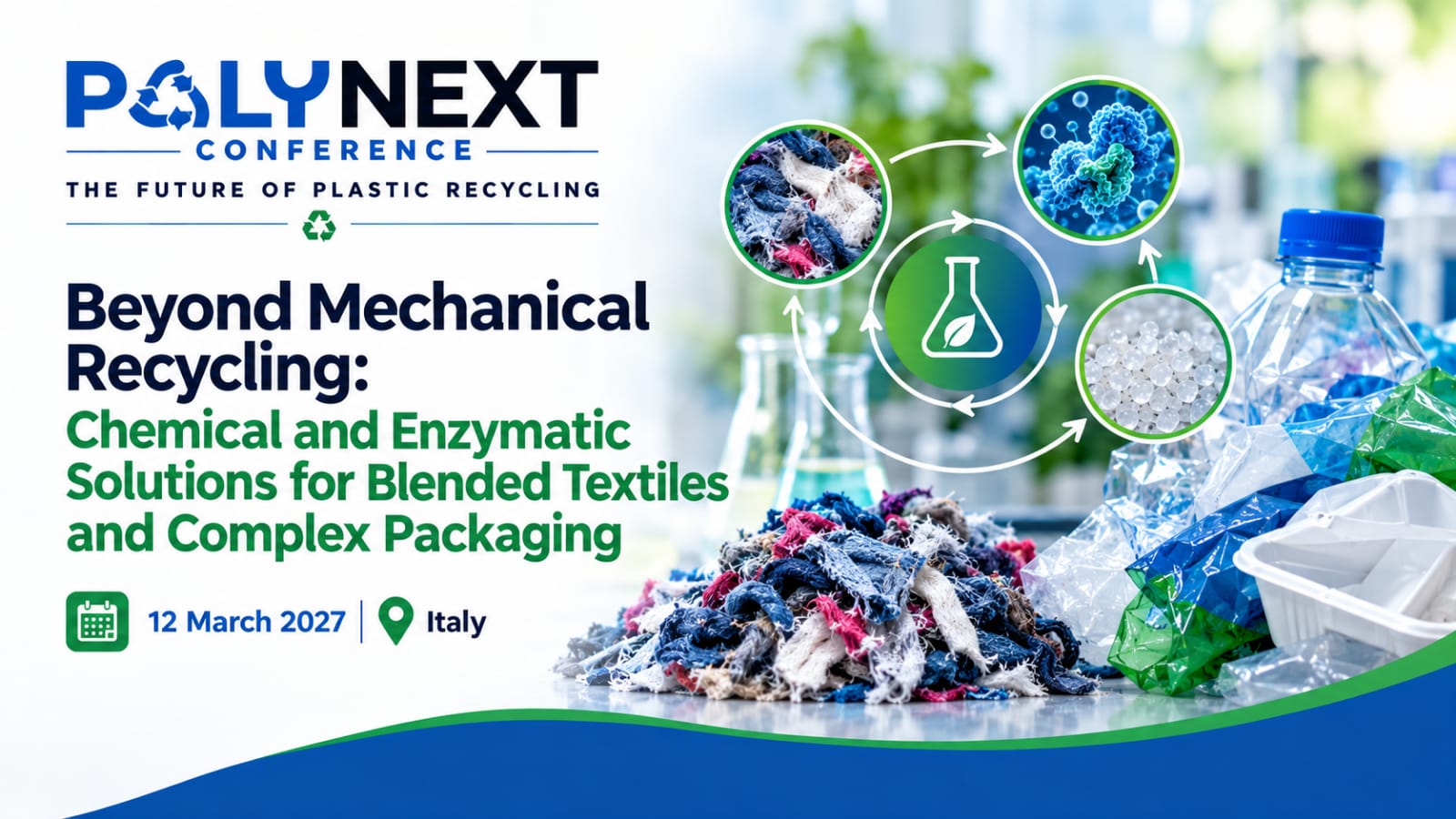
Mechanical recycling remains essential to the circular economy, but it cannot address every waste stream. Blended textiles, multilayer packaging, colored plastics, adhesives, and contaminated post-consumer materials often fall outside the reach of conventional sorting and reprocessing. Chemical and enzymatic recycling offer a complementary path: breaking polymers down into monomers and feedstocks that can be used to create new, high-quality materials.
Why conventional recycling falls short
Mechanical recycling performs best with clean, sorted, single-polymer waste such as clear PET bottles or industrial offcuts. Once materials become mixed, colored, layered, or contaminated, recyclers face declining yields, reduced material quality, and higher processing costs.
Polyester-cotton textiles are a clear example. Polyester and cotton have different chemical structures, making separation difficult. Mechanical recycling often shortens fibers and lowers quality, while traditional chemical methods can require high temperatures and intensive processing.
Complex packaging poses a similar challenge. Multilayer films combine different plastics, barrier materials, adhesives, and inks to protect food, medicines, and consumer goods. These layers are strongly bonded and chemically heterogeneous, making them difficult to separate through conventional recycling.
Chemical recycling: rebuilding polymers
Chemical recycling uses solvents, heat, catalysts, and other processes to depolymerize plastics into monomers or intermediate chemicals. These outputs can then be repolymerized into new plastics, enabling closed-loop recycling for materials that cannot be mechanically recycled without significant quality loss.
For PET-based textiles and packaging, chemical depolymerization can recover key monomers such as terephthalic acid and ethylene glycol. These can be used to manufacture new PET, offering a route to virgin-equivalent recycled material from colored, degraded, or mixed waste streams.
The goal is not to replace mechanical recycling. It is to apply chemical recycling where it delivers the greatest value: difficult materials that currently have limited circular pathways.
Enzymatic recycling: selective and precise
Enzymatic recycling uses engineered biological catalysts to break down target polymers selectively. For PET, PET hydrolases can depolymerize polyester into reusable monomers under milder conditions than many conventional chemical processes.
This approach is particularly promising for polyester-cotton textiles. Recent research shows that cellulase can break down the cotton fraction, while engineered PET hydrolase depolymerizes the polyester. In one study, monomer recovery reached 90–92% across different PET-cotton blends, with recovered terephthalic acid achieving purity above 99%.
The result is a more selective recycling process: one material stream can be recovered without destroying the value of the other. This makes enzymatic recycling especially relevant for mixed-fiber textiles, one of the most persistent challenges in textile circularity.
A timely opportunity for Italy
Italy’s textile districts, packaging manufacturers, plastics processors, and chemical sector are well positioned to lead Europe’s next phase of polymer circularity. The country combines industrial expertise, established supply chains, and growing demand for high-quality recycled materials.
Policy is also accelerating the shift. EU Member States must now operate separate collection systems for used textiles, while the revised Waste Framework Directive requires collected textiles to undergo sorting before potential shipment. At the same time, the EU Packaging and Packaging Waste Regulation requires systems for the return and separate collection of all packaging waste to support high-quality recycling.
These measures will increase the volume of material entering recycling systems. The critical question is whether that material can be converted into high-value secondary feedstock rather than exported, incinerated, or downcycled.
From waste to industrial feedstock
The next stage of circularity will be integrated rather than fragmented. It will require better collection and sorting, advanced separation technologies, depolymerization capacity, and strong connections between recyclers, fiber producers, resin manufacturers, and packaging brands.
Chemical and enzymatic recycling will not solve every plastics challenge alone. But together with mechanical recycling, they can expand the range of materials that can be recovered, reduce reliance on virgin fossil-based feedstocks, and create new value from waste streams once considered unrecyclable.
Join the conversation at PolyNext Awards and Conference Italy
How can Italy turn blended textiles and complex packaging into reliable feedstocks for new materials? What investments, partnerships, and policy frameworks are needed to move chemical and enzymatic recycling from promising pilots to industrial scale?
Join industry leaders, recyclers, technology providers, brand owners, and policymakers at polyNext Awards and Conference Italy to explore the technologies, business models, and collaborations shaping the next generation of plastics circularity.
Learn more: https://polynextconf.com