Recycled plastics are central to Europe’s circular packaging ambitions. But when the end use is food contact, circularity must meet a higher standard: recycled material must be demonstrably safe, consistently high quality, and compliant with strict regulatory requirements.
The challenge is not whether recycled plastics can be used in food packaging. In many cases, they can. The challenge is ensuring that every stage—from collection and sorting to decontamination, testing, and conversion—protects consumers without slowing the transition to circular packaging.
Why food contact is different
Once plastic packaging has been used, it may carry residues from its previous contents, as well as chemical contaminants introduced during use, collection, or sorting. Even plastics originally used for food can contain incidental contaminants whose type and concentration vary by source and collection method.
Microbiological contamination must also be controlled during recycling, with the effectiveness of these controls depending on the technology and operating conditions. Chemical contaminants require particular attention because their identity and concentration can vary according to the source of the plastic waste, its previous use, and the collection and sorting methods.
For this reason, food-grade recyclate requires stricter controls than ordinary recycled plastic. It depends on controlled input streams, validated decontamination, consistent process monitoring, and clear traceability to meet the relevant food-contact safety requirements.
Regulation sets the framework
In the EU, food-contact recycled plastics are regulated under Regulation (EU) 2022/1616, most recently consolidated on 3 December 2025. The European Food Safety Authority assesses recycling processes before they can be used to produce food-contact materials in the EU.
Under the EU framework, the European Food Safety Authority (EFSA) assesses the safety of relevant plastic recycling processes for food-contact applications. The assessment considers the recycling technology, decontamination efficiency, and intended conditions of use. Evidence from challenge tests and other appropriate scientific data helps establish whether potential contaminants can be reduced to levels that do not pose a safety concern.
For brands, this creates both an obligation and an opportunity. Compliance is essential, but a reliable supply chain for food-grade recycled plastics can also support product differentiation, supply chain resilience, and regulatory readiness.
The technical hurdles
Producing safe food-grade recyclate depends on several linked capabilities:
Controlled feedstock: High-quality collection and sorting are essential to reduce contamination before recycling begins.
Validated decontamination: Recycling processes must remove or reduce chemical contaminants to safe levels.
Process consistency: Safety cannot depend on a single successful test; it must be maintained across batches, seasons, and changing input streams.
Traceability: Brands and regulators increasingly need evidence of where material came from, how it was processed, and whether it meets the intended food-contact application.
Application-specific performance: A recyclate suitable for one food-contact format may not be suitable for another, particularly where hot-fill, long shelf life, fatty foods, or direct contact are involved.
Designing for safety and circularity
The most effective approach is safe by design. Rather than treating safety as a final compliance check, brands, converters, and recyclers should build it into packaging decisions from the start.
That means selecting recyclable formats, minimizing incompatible materials, designing for effective sorting, and specifying recycled content only where the supply chain can prove safety and consistency. It also means closer collaboration between packaging developers, food manufacturers, recyclers, and technology providers.
A clear PET beverage bottle illustrates this approach. Designed with a single-polymer PET structure, a compatible closure, and minimal labelling, it can be easier to identify, sort, and direct into a suitable recycling stream. After collection, the bottle is washed and processed using an appropriate recycling technology. For food-contact applications, the recycling process must demonstrate effective contaminant removal through suitable scientific evidence, including challenge testing where applicable. The resulting food-grade recycled PET (rPET) can be used in new beverage bottles only when the recycling process and the material meet the applicable food-contact requirements and are suitable for the intended use.
In this model, safety is built into every stage, from packaging design and collection to recycling technology and the intended food-contact application. This integrated approach helps ensure that recycled plastics are traceable, consistently processed, and suitable for their next use.
The PolyNext Awards and Conference Italy
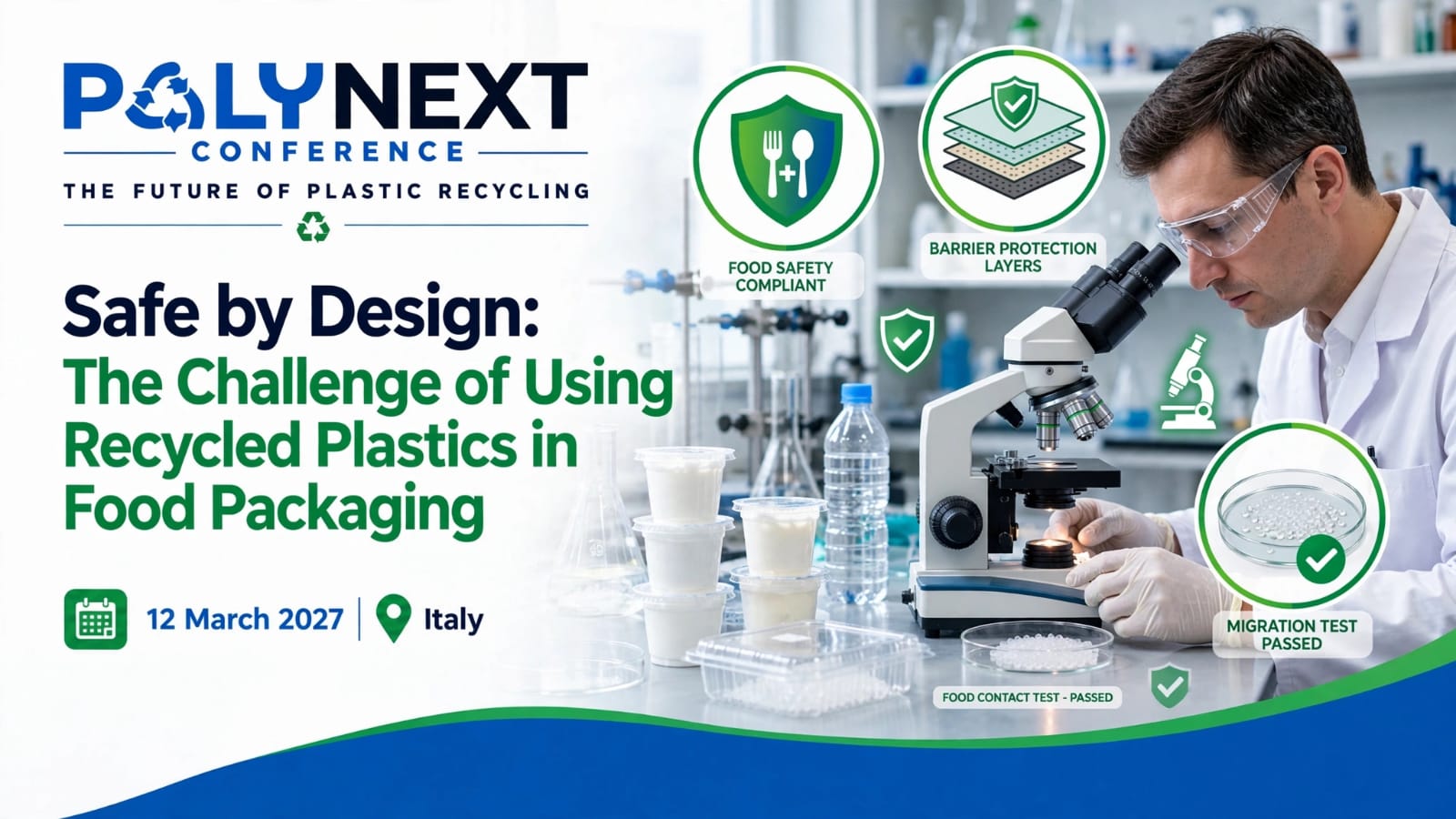
Ensuring food-contact safety while increasing the use of recycled plastics will remain an important challenge for Europe’s packaging industry. The PolyNext Awards & Conference Italy 2027 will take place on 12 March 2027 in Rome, bringing together professionals from plastic recycling, sustainable packaging, the circular economy, and material innovation.
For organizations developing food-grade recycled plastics, investing in decontamination technologies, or improving packaging recyclability, the event offers an opportunity to exchange industry insights, explore practical solutions, and build partnerships to support safer and more circular packaging systems.
Join industry professionals working to advance safe, traceable, and sustainable plastic recycling.
Register now: https://polynextconf.com